For One San Diego Mother and Son, College Is a Journey They’re Taking Together
September 8, 2026 | By National Rainbow College Fund
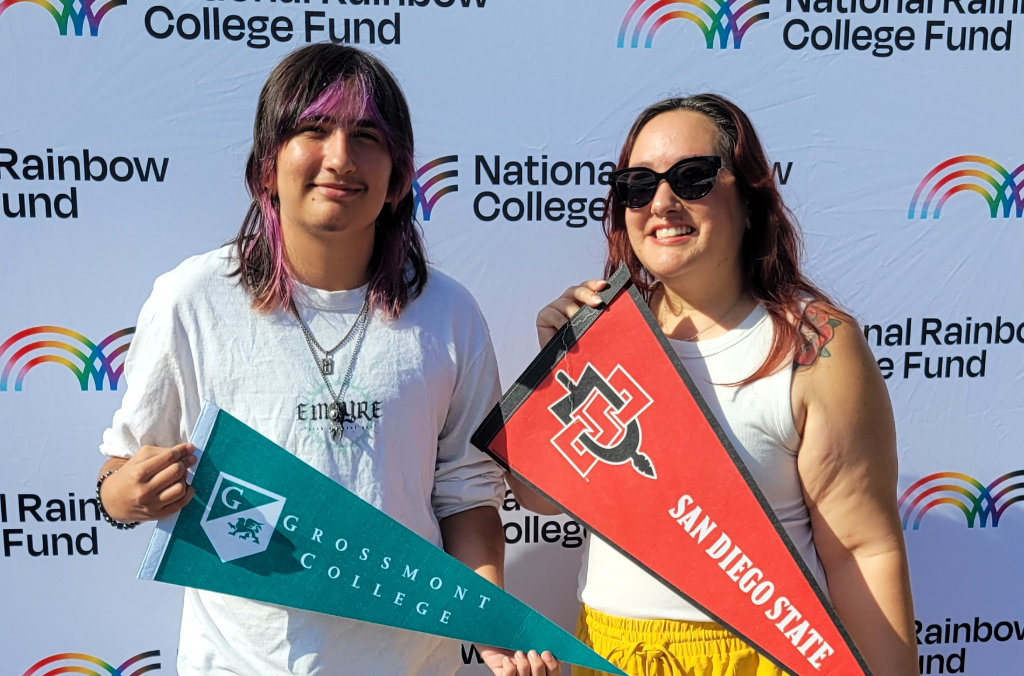
When Felicia decided to return to college, she wasn’t sure where the decision would lead.
The 48-year-old mother had already earned her associate degrees in psychology and behavioral science, but after watching her son, Ace, navigate his own challenges in school, she began thinking more seriously about how she could turn her experience supporting young people and families into a career.
Felicia had become someone other parents and young people often turned to for guidance, particularly when they were struggling to find resources or understand how to support their children. Returning to school offered a path toward doing that work professionally.

Today, Felicia is studying LGBTQ Studies, with minors in Counseling and Social Change and Psychology, at San Diego State University. Her 18-year-old son, Ace, recently graduated from high school and is beginning his own college journey at Grossmont College, with plans to eventually pursue architecture.
Neither expected they would become college students at the same time.
For a family navigating higher education without generations of experience or significant financial resources to fall back on, however, getting there has required more than deciding to pursue a degree. Tuition is only part of the cost. Books, transportation, school supplies and everyday living expenses can quickly make continuing an education financially difficult.
Those pressures now exist twice within the same household
Felicia is balancing her education with the responsibilities of supporting her family. Ace is beginning college while thinking about expenses as basic as a backpack, textbooks and transportation.
Both received scholarship support through National Rainbow College Fund (NRCF), helping provide the financial stability they need to continue their education.
“We don’t always have that kind of built-in family assistance,” Felicia said.
Instead, they’ve built their own.
They sit together with laptops working through scholarship applications. They remind each other about deadlines and read one another’s essays. Felicia helps Ace navigate applications and college processes she has only recently learned herself, while Ace offers encouragement when his mom begins to question whether she can take on the next challenge.
For Ace, watching his mother and stepfather return to school also changed what he imagined for himself.
“I definitely got inspired a bit, because I was like, okay, I could actually do this,” he said.
For much of high school, Ace assumed he would graduate and begin working. College didn’t always feel financially realistic. But seeing his parents pursue their own degrees made higher education feel more attainable.
“I didn’t want to just bounce around jobs forever,” he said. “I would like to actually get a degree that I can do something with.”
Without scholarships, Felicia said, their educational plans would look very different.
“I don’t think I would have even attempted to go through college,” she said.
Scholarship support has also helped Felicia provide the stability she wants Ace to have while he pursues his education. She wants him to be able to save what he earns while she continues covering necessities such as housing, food and his phone.
NRCF’s privacy-first scholarship program is designed to protect access to higher education for LGBTQ+ students and allies, including students whose financial stability, safety or family support cannot always be assumed. Students do not have to make their personal lives public to receive support.
For Felicia and Ace, that support is helping them maintain their educational momentum while also creating possibilities beyond the next semester.
Ace hopes to eventually transfer and study architecture. Through NRCF, he has also been connected with a mentor who can offer guidance in a field Felicia readily admits she doesn’t know how to navigate herself.
Felicia is looking forward to using her education to help young people and families find the guidance, support and resources they need to navigate challenges in their own lives.
The significance of their shared journey became particularly clear when Felicia and Ace attended San Diego Foundation’s annual Scholarship Celebration—not as a student and his guest, but as two scholarship recipients.
Sitting together among students and donors, they realized how unusual their story was.
“That was surreal for me,” Felicia said.
Ace agreed. Until then, attending college alongside his mom had simply become part of their family’s life. At the event, he began to see it differently.
“I thought, oh, I guess this is special.”
Their story is also a reminder that educational opportunity doesn’t necessarily move through a family in a straight line.
Sometimes a parent shows a child that college is possible.
Sometimes a child gives a parent a reason to return.
And sometimes they’re filling out scholarship applications at the same kitchen table, figuring it out together.
For Felicia, receiving support has already changed how she thinks about what she may someday be able to give someone else. She and her partner have talked about eventually sponsoring a student themselves.
“If we could get to the point where we could sponsor a kid,” Felicia said, they would have an opportunity to “pay it forward and also help that many more kids.”
Seeing the support Ace has received has made that possibility particularly meaningful to her.